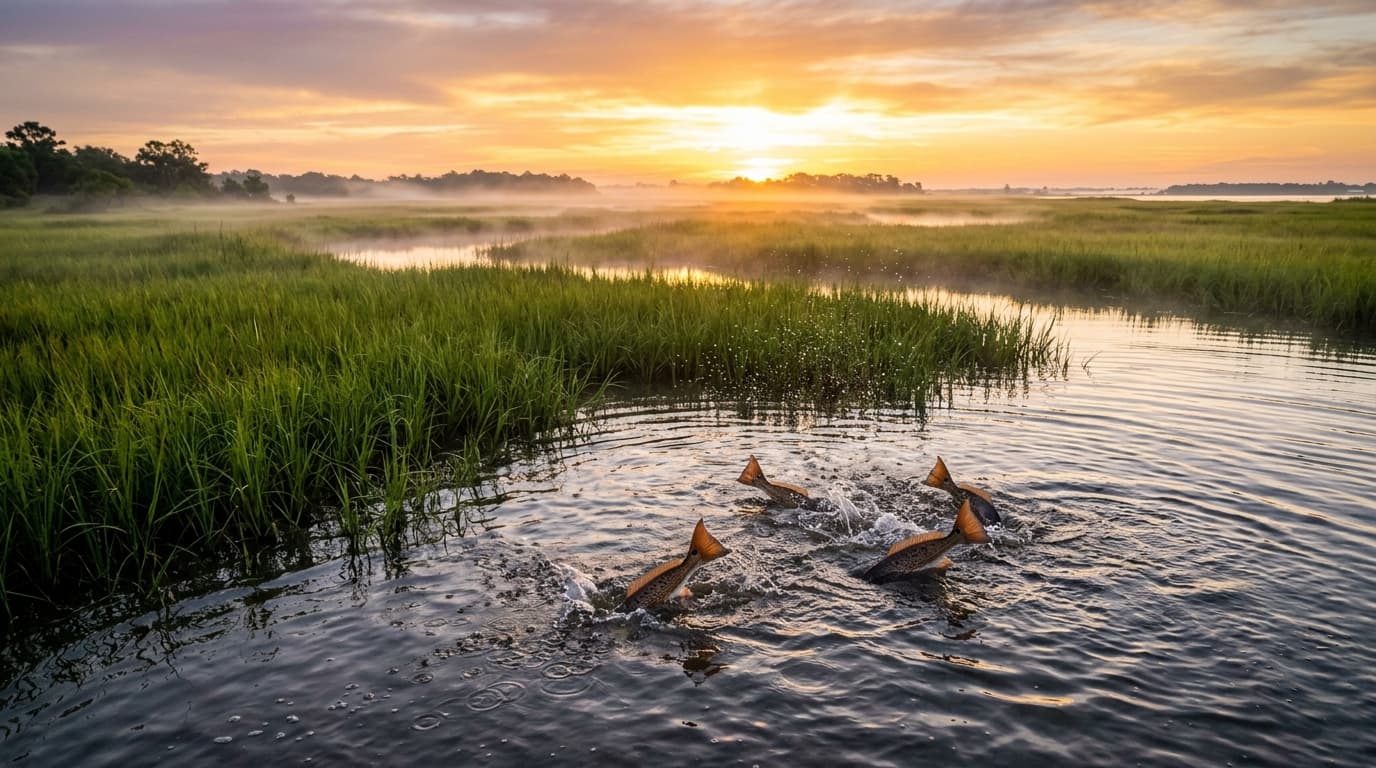
Redfish movement is entirely predictable. Not by the clock — by the tide. But published tide charts show the reference station miles away. Your water might lag by an hour or shift differently. The only way to truly know your system is to log what actually happens when the tide moves. Building a personal tide calendar for inshore redfish is one of the most effective things you can do to improve your catch rate.
Why Reference Stations Aren't Enough
NOAA tide predictions at tidesandcurrents.noaa.gov show you exact high and low times for reference stations. But your flat is not the reference station. Inshore systems — especially shallow flats, creeks, and back bays — can lag the reference station by 30 minutes to 2+ hours depending on depth, bottom type, and channel layout.
A creek mouth that lags the reference station by 90 minutes means the bait push occurs 90 minutes later than the NOAA chart shows. Redfish follow the bait. If you're fishing peak incoming based on NOAA, but your water doesn't actually turn incoming until 90 minutes later, you're sitting on a dead bite waiting for a tide that hasn't arrived.
The lag is consistent. Once you log it twice, you can apply it every season. A flat that runs 75 minutes behind the reference station runs 75 minutes behind every tide cycle, every year. That lag is your edge — the angler who knows it is fishing the actual tide while everyone else is guessing.
What Redfish Actually Key On
Redfish respond to tide movement, not absolute water level. Incoming tide pushes bait and water into the flat. Outgoing tide pulls it out. The 2-hour window around the tidal shift — when water velocity peaks — is when redfish feed most aggressively. This is the proven window you want to be on the water.
Which tide phase produces depends on your location. A creek mouth flat might light up on the incoming. A back bay that runs shallow on the incoming might only become fishable on the outgoing. You can't know without logging. What you'll find after one season is that your best spots each have a specific window — and that window repeats with reliable precision tide after tide.
Temperature also layers into this. Fall and winter tides fish differently than summer because redfish metabolism changes with water temperature. A low-70°F flat on an incoming summer tide may produce aggressively from 8am to 10am. The same flat at 58°F in November might not come alive until water has been moving for 90 minutes. Log the temperature alongside the tide data to find these nuances.
Building Your Personal Tide Calendar
For one full season, log the tide stage and time at every successful catch. Not "incoming tide" — what time relative to the reference station's high/low? "Caught three redfish 45 minutes into the incoming, water still 2 feet below high tide at 63°F." Do this across multiple seasonal tides.
After 50–60 catches logged with tide times, patterns emerge. Maybe your creek mouth flat fires hardest 60–120 minutes into the incoming when temps are 58–64°F. Your back bay might produce best on the outgoing when the wind is southwest and the water is moving fast. These are repeatable conditions — and now you know them.
Moon phase amplifies this. Full and new moon tides have greater range and move more water. Your personal pattern at a full moon tide might be more aggressive than at quarter moon when less water moves. Log moon phase alongside tide and temperature. After two seasons you'll know which full moon tides at which tide stage in which temperature band produce the best fishing on your water.
What to Log on Every Trip
Build your tide calendar with these data points per trip:
- Date and tide cycle (which high/low, time of day)
- Lag from reference station at your specific flat or creek mouth
- Tide phase at first catch (how many minutes into incoming or outgoing)
- Water temperature at the fishing location
- Moon phase (full, new, quarter)
- Wind direction and speed
- Catches by location (not just "in the back bay" — specific spot)
Next season, check NOAA the night before. Pull up your notes for similar tide and moon phase. Fish the locations that have produced under matching conditions. You're no longer hoping the redfish show. You're executing a proven calendar built from your own data on your specific water.
Start logging your tide data at Bield: Fish on bieldfish.com. Track every trip, build your tide patterns, and find out exactly when and where redfish feed on your water. The angler who knows their local tide lags and phase patterns has a critical advantage over everyone fishing generic charts.
Bottom line: Published tide charts are a starting point — not a fishing plan. Your personal tide calendar, built from consistent logged observations, tells you exactly when your water turns on. Get started this season and build the most effective fishing tool you'll ever own.