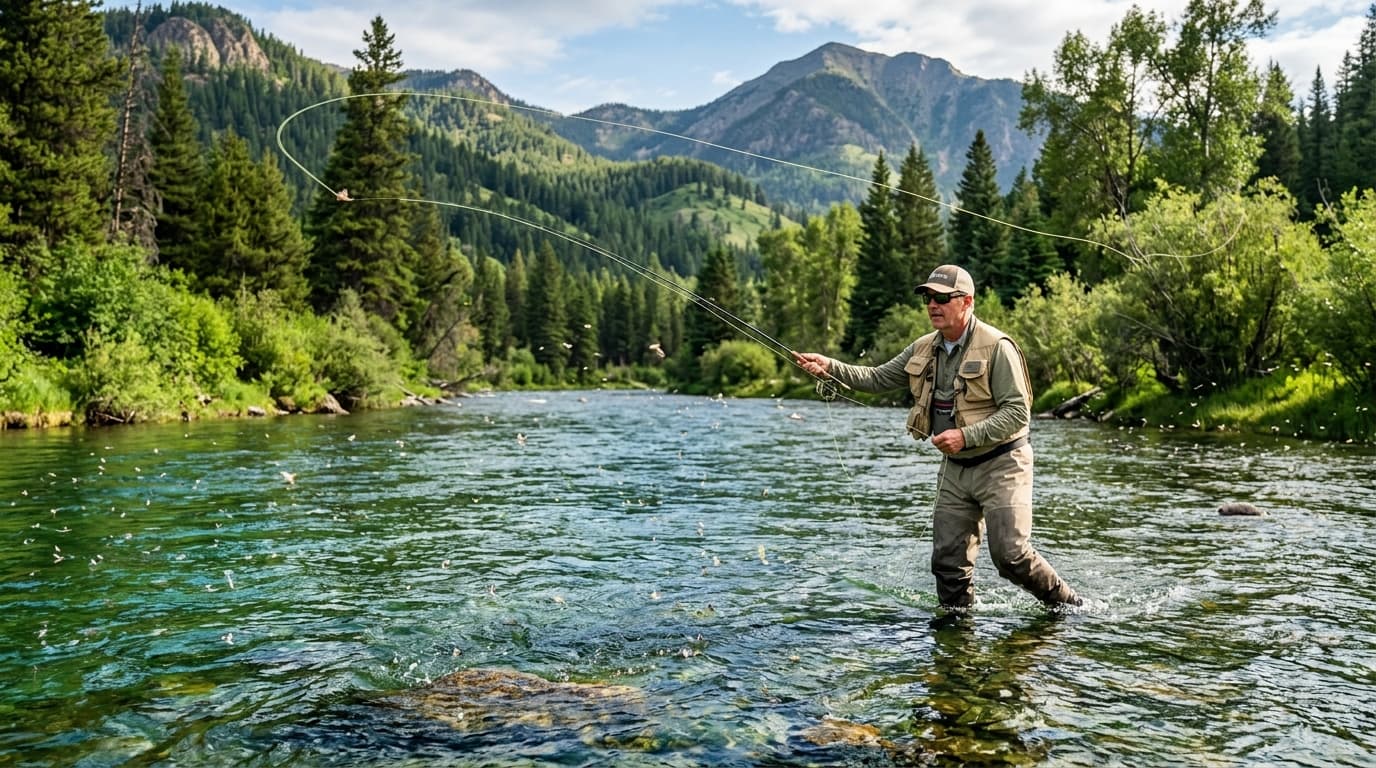
Hatch charts tell you PMDs emerge in June and caddis in July. That's a regional average across a watershed spanning hundreds of river miles. Your water might not see either hatch for weeks after the chart says to expect it. Personal emergence data built from your own observations beats any published chart — and it's not difficult to collect. Matching the hatch effectively means building your own calendar, not reading someone else's.
The Regional Average Problem
Published hatch charts aggregate data from multiple seasons and river sections. A PMD chart showing "June emergence" might reflect peak emergence at the 5,000-foot elevation zone while your water sits at 7,200 feet and typically peaks four weeks later. The chart is right for the average. It's useless for your specific stretch.
Water temperature drives emergence far more than calendar date. Two sections at the same elevation on opposite aspects — north-facing versus south-facing — can vary 3–4 weeks in hatch timing depending on how much sun each receives. The south-facing bank warms faster and the hatch kicks earlier. On the same river, the canyon section might emerge two weeks before the shaded gorge section a mile upstream.
Elevation changes of 500 feet shift hatch timing by 7–14 days. If you fish multiple waters at different elevations, you'll see the same hatch species emerge sequentially over weeks — but the chart shows one date for all of them.
What You Actually Need to Know
Log emergence on your water over two full seasons. Note the date, water temperature at the time of observation, and time of day the activity peaked. Even negative data matters — "July 4, no visible hatch, caught three on soft hackle swing, 51°F water." That tells you emergence hasn't started yet at that temperature on that water.
For effective hatch matching, track these data points on every trip:
- Date and water temperature at your fishing location
- Emergence observed (species if identifiable, size and color if not)
- Time of day activity peaked
- What fly pattern produced and at what presentation speed
- Air temperature (cold mornings delay emergence even when water is warm enough)
- What didn't work (negative data eliminates patterns that don't apply to your water)
After 40–50 observations across two seasons, your own data becomes predictive. You know your water turns on when temps hit 52°F, regardless of calendar date. You know that in a warm spring, emergence comes 10 days early. In a cold spring, it's late. You know your peak PMD window is the second week of July when temps stabilize in the 54–58°F band — not June, not August. The published chart told you June. Your data tells you the truth.
Building Your Personal Hatch Calendar
Next time you're on the water, write down one data point: date, water temp, what's hatching or not, what fished. One note per trip. After one season you'll have 10–15 observations. After two you'll have 30+.
By year three, you'll know your water's hatch calendar better than any guide book or published chart. You'll check the thermometer, pull up your notes, and know exactly what fly to tie on before you make your first cast. The published hatch chart becomes reference material. Your notes become the proven guide you actually trust.
Build your hatch journal in Bield: Fish at bieldfish.com. Log water temperature and emergence observations alongside your catch data. After two seasons you'll have the most effective matching-the-hatch tool that exists for your specific water — because it was built from your own observations, not aggregated averages.
Bottom line: Published hatch charts are averages. Your water isn't average. Two seasons of temperature-logged emergence data on your specific stretch will teach you more about matching the hatch than any guide book ever written. Start logging today.